Solving Childcare Visibility Issues with Decision Intelligence
Decision Intelligence, Childcare Management, Financial Planning, Operational Efficiency
It’s Usually Not a Fight — It’s a Visibility Problem
In most childcare programs, the real tension between enrollment and payroll does not surface as a loud argument — it appears as a quiet, recurring conversation that never truly gets resolved. As a senior software engineer working with decision intelligence systems, I see this pattern as a data and visibility defect, not a leadership defect.
The Conversation Every Childcare Leader Recognizes
It usually starts in an office, a hallway, or a quick check‑in between everything else. The owner states the financial imperative — “We need to fill every classroom.” The director responds with the operational constraint — “We don’t have the staff to support that.” Payroll pressure meets staffing reality, and the discussion slows down because both statements are correct and neither side has quantified visibility into the impact of the next move.
What follows is not a decision — it is a deferral. “Let’s just try it.” “Let’s see how next week goes.” “We’ll adjust if we need to.” The same conversation repeats the next week because the underlying system has not changed. The organization is operating without a decision model that connects enrollment, staffing, payroll, and margin in a single, inspectable structure.
Why This Is a Decision Intelligence Problem — Not a Communication Problem
From a technical standpoint, this is a classic visibility gap. The owner and director are attempting to optimize a multi‑variable system — enrollment, ratios, payroll, capacity, and margin — without a shared model. That is exactly the domain of decision intelligence: building explicit, testable representations of how operational inputs propagate to financial outcomes.
📌 Key Takeaway: If two leaders are “both right” but stuck, the missing piece is usually a shared decision model — not another meeting.
In childcare management, the critical questions are computational, not rhetorical:
What happens to payroll if this room is filled to licensed capacity?
What staffing pattern satisfies ratio requirements and coverage windows with minimal overtime?
Does incremental enrollment increase profit — or simply increase pressure and risk?
Without a model, leaders answer these questions with intuition and urgency. With decision intelligence — the type CenterIQ focuses on — they answer them with simulated outcomes and quantified tradeoffs.
Modeling Childcare Operations as a System
As engineers, we treat the program as a system with defined inputs and outputs. At a minimal level, a decision intelligence layer needs to model:
Enrollment inputs — age groups, schedules, tuition, and capacity by room.
Staffing structure — roles, wage rates, availability, and regulatory ratios.
Financial parameters — fixed costs, variable costs, and target operating margin.
From there, we can compute the impact of “fill this room” as a deterministic transformation. In code, the core idea looks something like this:
from dataclasses import dataclass
from typing import List


@dataclass
class RoomConfig:
    name: str
    capacity: int
    ratio: float          # children per staff member
    tuition_per_child: float


@dataclass
class StaffBand:
    role: str
    hourly_rate: float


def simulate_room_decision(
    room: RoomConfig,
    staff_band: StaffBand,
    hours_per_week: float
) -> dict:
    children = room.capacity
    required_staff = max(1, int(round(children / room.ratio)))
    weekly_tuition = children * room.tuition_per_child
    weekly_payroll = required_staff * staff_band.hourly_rate * hours_per_week
    margin = weekly_tuition - weekly_payroll

    return {
        "children": children,
        "required_staff": required_staff,
        "weekly_tuition": weekly_tuition,
        "weekly_payroll": weekly_payroll,
        "weekly_margin": margin,
    }
In a production‑grade platform like CenterIQ’s decision intelligence engine, this computation is far richer — spanning shift patterns, blended age groups, part‑time schedules, benefits, and overhead allocation — but the principle is identical. You convert a vague operational question into a concrete function that returns explicit financial and staffing implications.
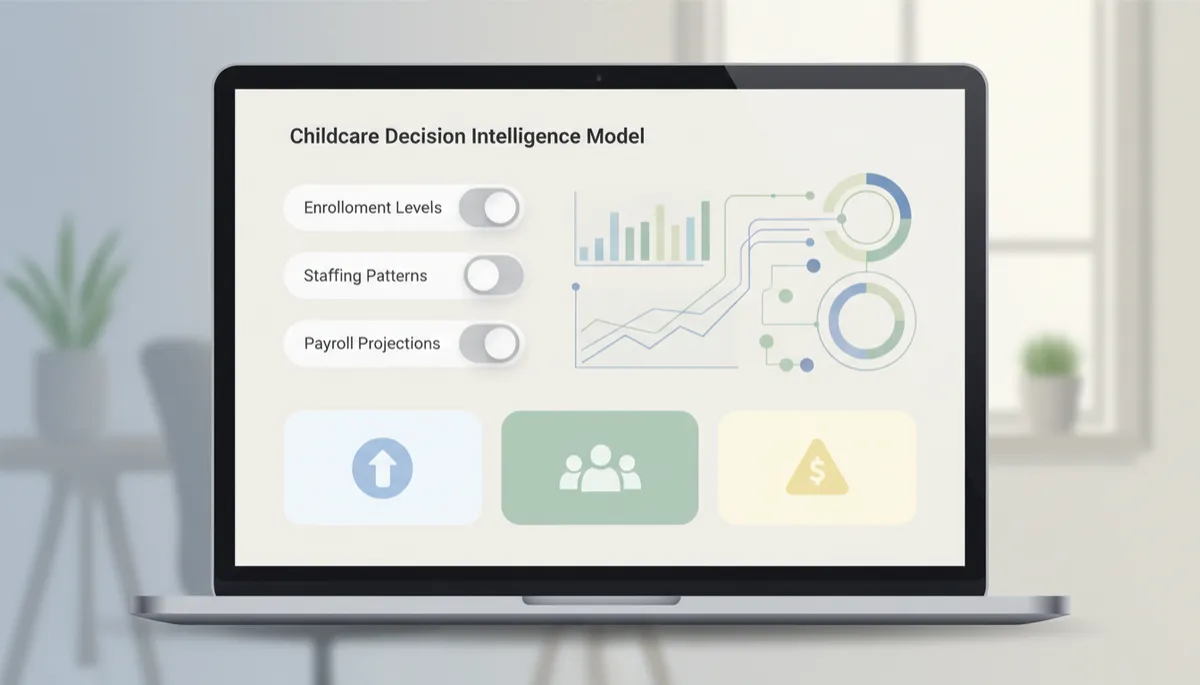
Scenario modeling replaces guesswork, turning recurring debates into data-backed decisions.
Connecting Decision Intelligence to Financial Planning and Operational Efficiency
Once this model exists, financial planning stops being a static annual exercise and becomes a continuous simulation. Leaders can ask:
If we add eight toddlers in Room B next month, how does that affect monthly margin and cash flow?
At what enrollment threshold does it become financially rational to add another full‑time teacher rather than rely on overtime?
Which room is the real constraint — staffing, square footage, or demand?
This is where operational efficiency emerges. Instead of reacting — hire and hope, delay and hope, fill and hope — leaders can deliberately choose the configuration that delivers stable classrooms and sustainable payroll. More children per room is not automatically more profit; in many cases, the marginal child erodes margin if staffing and scheduling are not modeled correctly.
💡 Pro Tip: The most profitable configuration is often the most stable configuration — decision intelligence helps you identify that equilibrium instead of chasing maximum headcount.
How the Conversation Changes When You Can “See” the Decision
With a decision intelligence layer in place, the owner–director dialogue does not disappear — it upgrades. The statement “We need to fill the room” becomes “If we fill this room to 16 children, the model shows we require 2.3 FTE at this wage band, payroll increases by 14%, and weekly margin increases by 6% — but only if we adjust coverage in the late afternoon block.” The discussion moves from opinion to scenario evaluation.
That is the core promise of CenterIQ’s approach to childcare management — not more disconnected reports, but a unified, intelligible model that lets leaders see the downstream impact of today’s enrollment and staffing choices before they commit. The tension remains, but it is framed by shared visibility rather than guesswork.
Conclusion: You Don’t Need to Choose Sides — You Need Visibility
The recurring debate between enrollment growth and payroll control is not a sign of failure — it is a signal that your decision model is implicit instead of explicit. When you surface that model through decision intelligence, you no longer have to choose between “owner logic” and “director logic.” You can see how enrollment and payroll actually work together in your specific program, with your specific constraints.
Once you can see it, you can lead it — with clearer financial planning, higher operational efficiency, and childcare management that is proactive instead of reactive. If you are ready to move from recurring conversations to resolvable decisions, explore the decision intelligence capabilities at https://di.centeriq.io/.